
A roller shade is a single flat panel of fabric on a tube at the head of the window. We buy the fabric on the roll, cut it to your actual opening in our Akron workroom, and hang it ourselves — in five opacities from a solar screen you can see straight through to a full blackout, with a cordless lift or a motor, and an open roll, a fascia, a cassette or a built wood cornice over the top.
Cut to your openings, in our workroom
We make what we install, and we have for over 40 years. Fabric arrives here on rolls. It is measured, squared and cut on our own tables, the tube is cut to the opening, and the crew that hangs it works for us.
The practical consequence shows up on the windows that are not a standard size. A shade ordered from a size chart has to be rounded to the nearest stocked width, and the difference is taken up in the gap at the edges. On a wide living-room span, a patio slider, a sunroom wall or a hundred-year-old opening that has settled out of square, that rounding is the difference between a shade that fits the hole and one that nearly does. We measure every opening in three places — top, middle and bottom — and cut to what is actually there.
How much light do you want to keep?
Opacity is a property of the cloth, and it is the first decision, before colour and before hardware. The category runs five rungs, and two of them get blurred by almost everybody who sells them.
Five rungs, from a view to no light at all
The same window, the same opening, five different fabrics.
| Opacity | What you notice in the room | Where it belongs |
|---|---|---|
| Sheer / solar screen | You keep the view out and most of the daylight; glare and UV drop sharply. Nothing is private after dark. | West and south-west glass, sunrooms, offices, anywhere the view is the point |
| Light-filtering | Daylight comes through softened and diffused. Shapes are visible against the glass at night. | Living rooms, kitchens, dining rooms |
| Translucent | Privacy in daylight, with the fabric holding a soft glow rather than going flat. | Bathrooms, street-facing front rooms, stairwells |
| Room-darkening | Most of the light is gone. A glow remains around the edges. | Ordinary bedrooms, guest rooms |
| Blackout | Essentially no light passes through the cloth itself. | Nurseries, day-sleepers, media rooms |
Two rules the whole industry blurs. Room-darkening and blackout are not synonyms — room-darkening leaves an edge glow by design. And blackout fabric is not a sealed opening: see below.
Blackout fabric does not, on its own, make a dark room
This is worth being blunt about, because it is the single most common disappointment in this category. A roller shade mounted inside the opening is cut narrower than the opening so that it can roll freely, which leaves a gap down each side by design. An open roll leaves the head open as well. The fabric can be perfect and the room will still have three lines of light in it.
Where the light actually gets in
Same window, same blackout fabric, two different rooms.
What closes those gaps is the mount and the header, not the cloth: an outside mount with a generous overlap, side channels, and a cassette or a cornice over the tube. More on room-darkening versus blackout, and how each header behaves at the top of the window.
Solar screens and openness
On a solar screen the openness percentage describes the weave, not the glass. A lower number means a tighter weave: less view out, more glare and UV stopped. A higher number means more view and less block. The category publishes 1%, 3%, 5% and 10%, with roughly 99% of UV blocked at the tightest and about 90% at the most open — that is the category's published range rather than a specification of ours, and we choose the number against your actual window at the consultation.
Then the part almost nobody explains: colour behaves opposite to intuition. A light fabric reflects more solar heat back out of the room, but it also scatters more light inside it, which can make glare on a screen worse. A dark fabric absorbs more heat but cuts glare hard and keeps the view out much crisper. So if the complaint is “this room is hot”, lean light; if it is “I cannot see my monitor at four o'clock”, lean dark. More on west-facing windows.
Manual or motorized
Cordless is the default. There is no operating cord, which is both the tidiest answer and the one the Consumer Product Safety Commission points to where young children are present. A motor earns its place on tall or stairwell glass you cannot reach, on a run of patio doors nobody wants to operate one at a time, in a child's room where there should be no cord at all, and on rooms that need the shade down before the afternoon sun arrives. On an ordinary reachable bedroom window, a cordless lift is a complete answer. See motorized shades.
Finish the top
Four options, and one of them decides whether a bedroom works.
The four headers, in section
Cut through the head of the window and look sideways. Same shade every time; only the header changes.
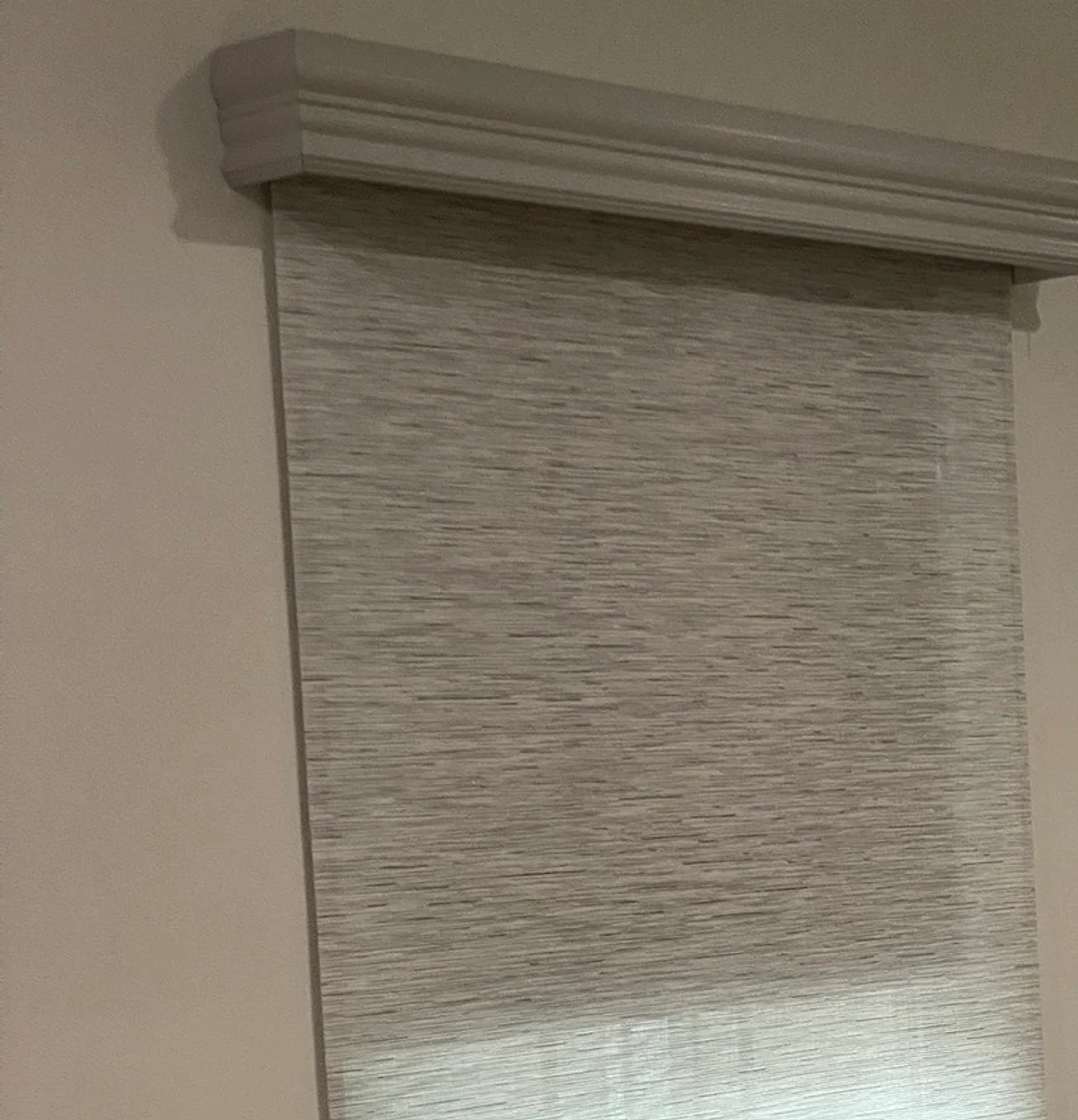
An open roll is the cleanest, most minimal answer and it is genuinely right in a lot of modern rooms — it also leaks light over the top and collects dust on the exposed roll. A fascia covers the front and the underside. A cassette encloses the tube completely. A built, painted wood cornice hides the tube, the brackets and the light gap, and ties a modern roller into a room with traditional millwork. See headers, cornices and valances.
Want blackout behind the colour?
If you want a fabric you like through the day and a dark room at night on the same window, that is a dual roller: one bracket at each side carrying two independent rolls, your fabric in front, blackout behind, each dropping on its own. It is not a banded or zebra shade, which is one roller carrying one striped fabric. See how a dual day-night shade works.
And if you want the shade to do the sun while something softer does the room, drapery over a roller is what a workroom is for — both are made here, so they are specified together rather than bought separately and made to fit each other afterwards.
Questions people ask
What is the difference between room-darkening and blackout?
Room-darkening cuts most of the light but leaves a glow around the edges. Blackout is the fabric itself blocking essentially all light through the cloth. Neither one makes a room dark on its own, because a roller shade is cut narrower than its opening — the edges are what let light in, and an outside mount with overlap, side channels, or a cassette or cornice over the top are what close them.
What does the openness percentage on a solar shade mean?
It is how open the weave is. A lower percentage means a tighter weave: less view out, more UV and glare blocked. A higher percentage means more view and less block. The category publishes 1%, 3%, 5% and 10%, with roughly 99% of UV blocked at 1% and about 90% at 10%. We pick the openness with you at the consultation, against the actual window and the actual sun.
Can I have roller shades and drapery on the same window?
Yes, and it is one of the most useful things a workroom can do for you. A solar or light-filtering roller handles the sun and the glare, and drapery over it handles the look, the acoustics and the draught around the perimeter. We build both here, so they are specified together rather than bought separately and made to fit afterwards.
See the fabrics on your own windows
A designer brings the opacities to your rooms, measures every opening, and prices it before they leave.